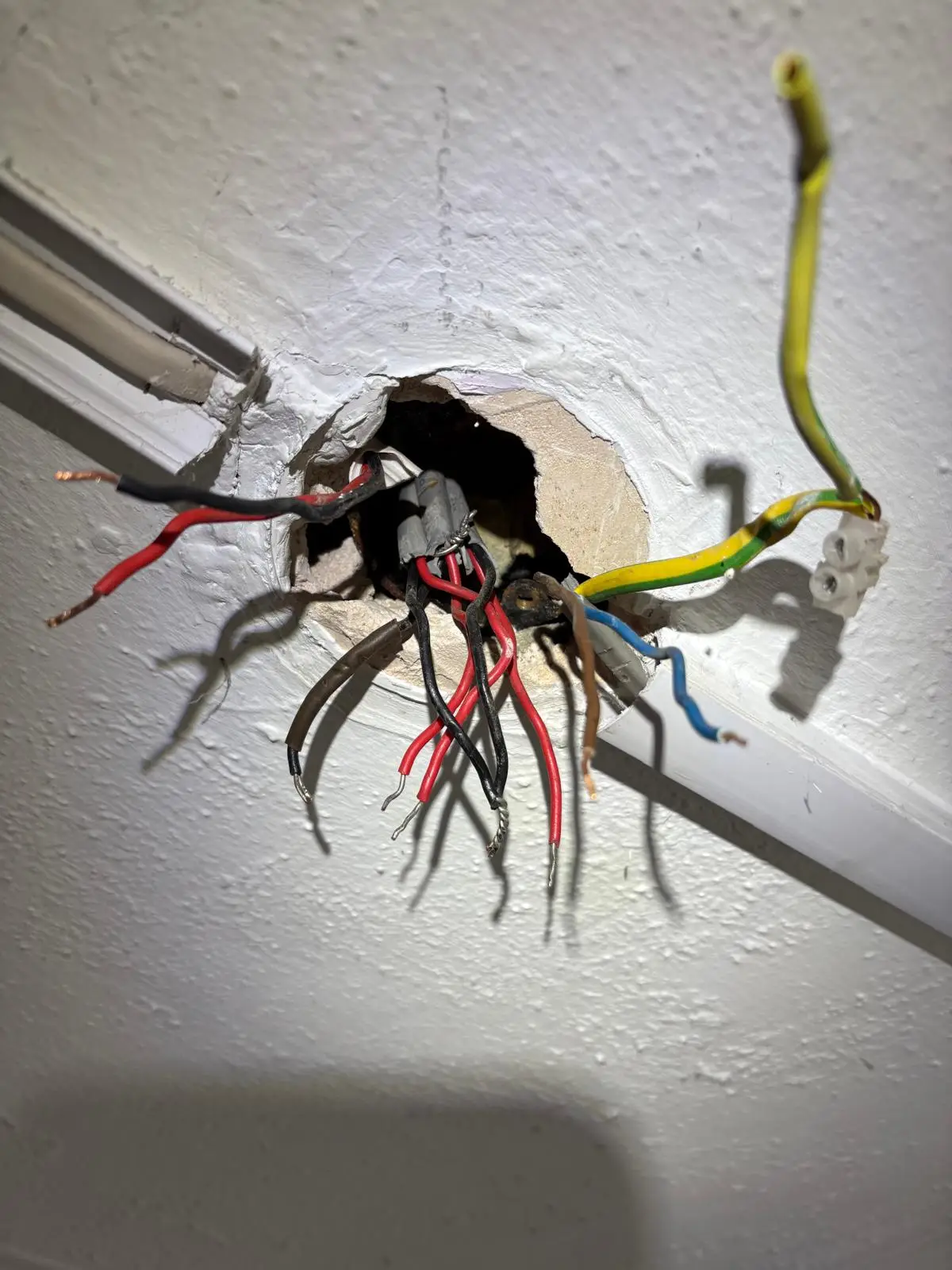
Cable fault finding is done by isolating the circuit, testing the conductors and insulation, splitting the circuit into sections and tracing the cable route until the fault is narrowed down to one length of cable. Continuity and insulation resistance tests then help narrow down the affected section before any wall or floor is opened. Paul, the Weybridge electrician behind Bring It Ohm, explains each stage and what happens once the fault is found.
What counts as a cable fault?
A cable fault is a defect in a conductor, its insulation or the cable that stops a circuit working safely. Common examples include:
- insulation that has broken down, letting current leak to earth
- live and neutral touching, which causes a short circuit
- an intermittent fault that only appears when the cable warms up, gets damp or moves
These faults are usually caused by a nail, screw or drill bit through a cable, floorboards crushing a cable, rodents, heat, water or plain old age. Faulty sockets, loose terminals and appliances can produce very similar symptoms, so the first job is to confirm the cable really is the problem. Paul’s guide to short circuits, earth faults and arc faults explains how those symptoms differ.
How is cable fault location done?
Cable fault location works from broad tests down to narrow ones, so the search area shrinks at every stage before anything is disturbed.
1. Confirm the affected circuit
The investigation starts by matching what you’ve noticed to the circuits in your consumer unit, such as which sockets are dead, which breaker trips or what was happening at the time. Starting on the right circuit saves hours.
2. Isolate and prove dead
The circuit is safely isolated, locked off so nobody can switch it back on and proved dead with an approved voltage indicator. HSE guidance on electrical test equipment (GS38) sets out the standard for the testers and leads used.
3. Test the conductors and insulation
Continuity testing shows whether each conductor has an unbroken path from end to end, which reveals breaks and high resistance joints. Insulation resistance testing applies a test voltage between conductors and between each conductor and earth, which shows where insulation has broken down or where current is finding a path it shouldn’t.
4. Split the circuit into sections
The circuit is then divided at accessible points such as sockets, junction boxes and ceiling roses, and each section is tested on its own. On a ring final circuit with twelve sockets, this can quickly cut the suspect cable down to the run between two of them.
5. Trace the cable route
Cables buried in plaster, under floors or in the ground rarely run where you’d expect. A cable tracer sends a signal along the conductor so the route can be followed through walls and floors and marked out.
6. Pinpoint and confirm
Once the tests point to one length of cable between two accessible points, the results are checked against the traced route before deciding exactly where to open up. That way any access is made in the right place first time.
Which tests help locate a cable fault?
No single instrument finds every cable fault, so the right combination depends on whether the fault is a break, a short, an earth fault or something intermittent.
| Test or method | What it shows |
|---|---|
| Continuity testing | Whether each conductor is unbroken between two points |
| Insulation resistance testing | Whether insulation between conductors, or to earth, has broken down |
| Sectional testing | Which part of the circuit contains the fault |
| Cable route tracing | Where a hidden or buried cable actually runs |
The aim is a sequence of tests that removes a little more uncertainty each time. In most homes, continuity, insulation resistance and sectional testing narrow the fault down to one cable run between two accessible points.
How do continuity and insulation resistance tests narrow down the fault?
Continuity and insulation resistance tests narrow down the fault by comparing readings taken at each accessible point along the circuit. Where the readings change from healthy to faulty, the damage lies in the cable between those two points.
A continuity test that passes at one socket and fails at the next shows a break in the cable between them. An insulation resistance reading that drops when a particular section is connected shows where insulation has broken down or where a nail or screw has pierced the cable. Testing one section at a time like this lets Paul pin the fault to a single length of cable, even on long runs such as a supply to a garden office, garage or outbuilding.
Can a cable fault be found without damaging walls or floors?
Most of the search for a cable fault can be done without damaging walls or floors, using electrical tests, accessible points and route tracing. If the damaged section is hidden and there’s no access point nearby, a small, targeted opening may still be needed to reach it.
Careful testing keeps that opening as small as possible. Lifting one floorboard or cutting one neat access hole in plaster is very different from chasing out a whole wall to find a fault by trial and error.
What happens once the cable fault is found?
Once the fault is found, Paul works out what failed and, where possible, why, then recommends either a local repair or replacing the damaged length of cable. A single nail through a cable can often be repaired with an approved joint, while cable damaged by heat or age along its length is better replaced.
After the repair, the circuit is tested again to confirm it’s safe and you receive the appropriate certificate for the work. If testing shows the cable isn’t the cause after all, the investigation moves back to the accessories, appliances and protective devices on that circuit. Widespread insulation breakdown across several circuits can point to a wider problem, and in older homes a partial or full rewire is sometimes the more sensible long term fix.
Case study: hall lights not working after building work in Walton-on-Thames
Paul was called out to a house in Walton-on-Thames where the lighting in the hall had stopped working after some building work. He isolated the lighting circuit and tested it, which traced the fault to a cable that had been accidentally cut during the building work.
He opened the wall back up, replaced the damaged cable and tested the repair to confirm the circuit was safe. The whole job was completed in a day, and Paul issued a Minor Works Certificate for the work.
Is cable fault finding safe to do yourself?
Cable fault finding isn’t safe to do yourself, because it involves isolating circuits, proving them dead and using specialist test equipment at voltages that can cause serious injury. HSE guidance on electrical safety says work should be carried out dead wherever possible, by people who are competent to do it.
What you can do is note the details that help an electrician. Write down which sockets or lights have stopped working, which breaker trips, when it happens and whether any building work, drilling or flooding came before it. That information often points the testing in the right direction from the start and may save time.
Frequently asked questions
How do electricians find where a cable fault is?
Electricians find a cable fault by isolating the circuit, testing continuity and insulation resistance, dividing the circuit into sections at accessible points and tracing the cable route. Comparing the readings at each point narrows the fault down to the cable between two of them.
How long does cable fault finding take?
Most domestic cable faults are found within a few hours, typically between 1 and 2, though intermittent faults and long buried runs can take longer. A standard domestic diagnostic visit starts from £80.
How do you know which section of cable is damaged?
You know which section of cable is damaged by testing the circuit in sections and seeing where the continuity or insulation resistance readings change from healthy to faulty. The damage sits between those two points, and tracing the cable route then shows exactly where that length runs before any access is made.
What are the signs of a damaged cable in the wall?
The most common signs of a damaged cable in the wall are lights or sockets that stop working, an RCD or breaker that trips repeatedly, a burning smell with no obvious source and problems that started after drilling or fixing something to a wall. On a ring final circuit, sockets can keep working even after the ring is broken, so a damaged cable is not always obvious and testing is the reliable way to find it. Read more about why an RCD keeps tripping for the wider list of causes.
Need a Cable Fault Located?
Call Paul at Bring It Ohm in Weybridge to trace and repair the fault, covering Weybridge, Walton-on-Thames, Addlestone, Hersham, Cobham and Byfleet.