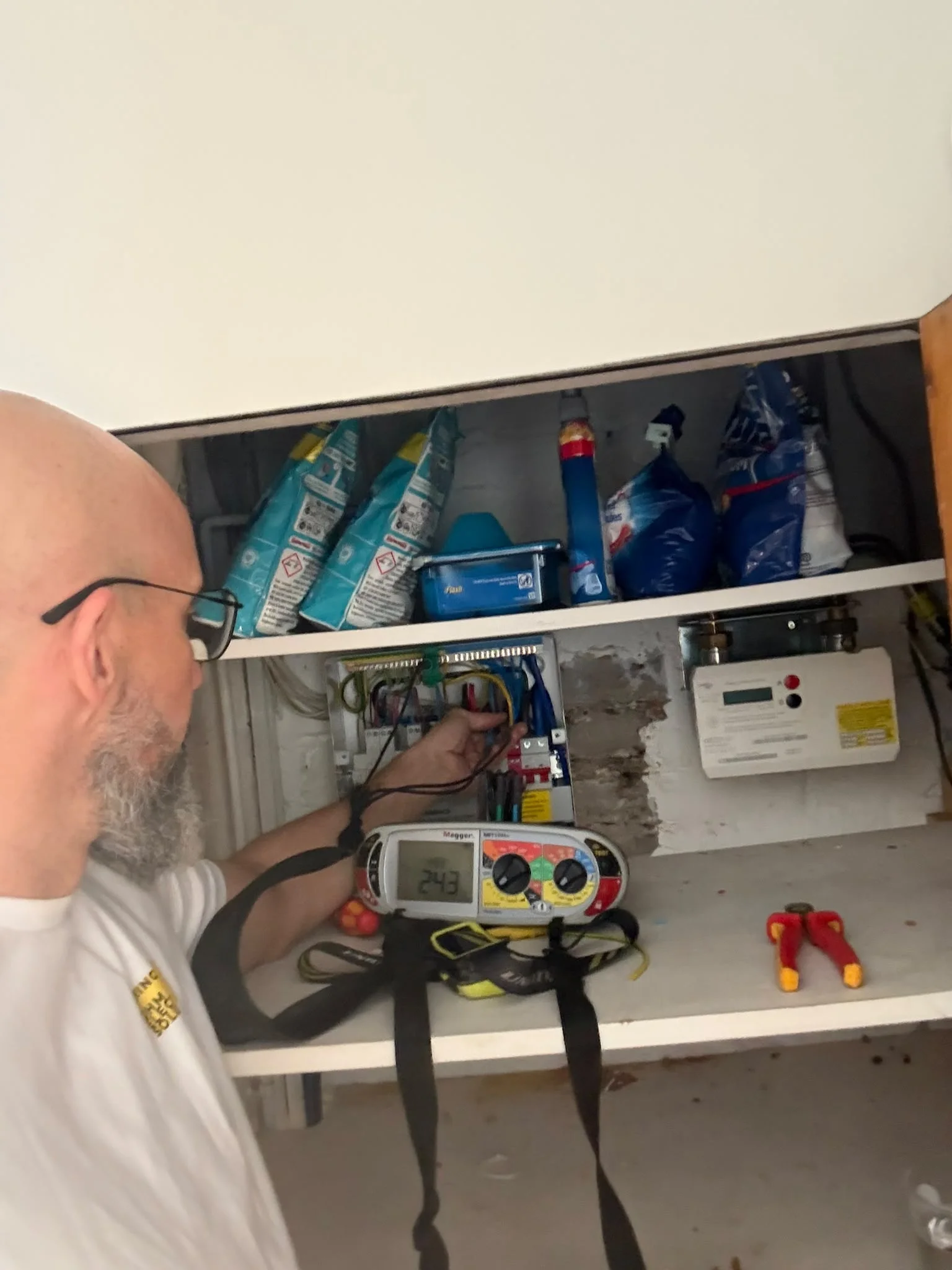
Consumer Unit Replacement & Fuse Box Upgrades in Weybridge
Paul Cerri at Bring it Ohm Electrical Solutions supplies, fits and certifies metal consumer units built to the current BS 7671 wiring regulations across Weybridge (KT13), Walton-on-Thames, Cobham and the surrounding areas. Replacing an outdated rewireable fuse box with individual RCBOs and a Type 2 Surge Protection Device (SPD) typically costs between £550 and £1,150, depending on circuit count and bonding requirements. Every installation includes full circuit testing, an Electrical Installation Certificate (EIC) and Part P notification to Elmbridge Borough Council through NAPIT. Call 07885 694524 for a transparent, written quote.
- Metal consumer units with individual RCBOs
- EIC certificate and Part P notification included
- Free written quotes with no call out charge
- BS 7671 wiring regulations compliant


Transparent Consumer Unit Replacement Pricing
Every quote is written and itemised after Paul has surveyed your existing fuse board, earthing arrangement and circuit count. The figures below include full testing and certification, so you can budget with confidence before any work is booked.
-
Standard
8 to 10 Way Board
1 to 2 bed flat or small terraced house
£550 to £700Inc. testing & certification- Non-combustible metal enclosure
- 100A main switch and Type 2 SPD
- Full RCBO protection
- EIC certificate and Part P sign off
-
Most popular
12 to 16 Way Board
3 to 4 bed semi or detached house
£700 to £850Inc. testing & certification- Metal enclosure and Type 2 SPD
- Individual compact RCBOs
- Main protective bonding check
- Full testing and certification
-
Large or complex
Split Board
4+ bed detached, outbuildings or EV charging
£850 to £1,150+Inc. testing & certification- Larger capacity board with surge protection
- Dual RCD or RCBO split
- Dedicated EV charger or heat pump ways
- Submain checks to outbuildings
Additional costs only arise where testing uncovers a defect, such as missing main bonding, damaged cabling or an insulation fault. Paul explains any issue in plain English and prices the remedial work before it goes ahead.
Signs Your Property Needs a Fuse Board Replacement
Many homes across Weybridge and Elmbridge still rely on fuse boxes installed decades ago. These are the symptoms Paul sees most often when homeowners call about their electrics:
-
Rewireable Ceramic Fuses or Wooden Backing Old boards with rewireable fuse carriers or wooden mounting panels fail current fire containment standards and lack modern earth fault protection.
-
No RCD or Test Button If your board has no test button marked "T", your circuits lack Residual Current Device (RCD) protection against electric shock and fatal electrocution.
-
Nuisance Tripping Across Half the House Older dual RCD boards protect several circuits with one RCD, so a fault on a single socket cuts power to half your home. Individual RCBOs isolate a fault to the affected circuit alone.
-
Planning Extensions, Solar or an EV Charger Adding demanding equipment such as an EV home charger, heat pump or induction hob requires spare capacity, the correct RCD type and dedicated protective ways.
-
Flickering, Sizzling or Burning Smells Scorch marks around fuse holders or faint arcing sounds point to loose terminal connections and an immediate fire risk.
-
An EICR Recommending an Upgrade A landlord, buyer's survey or insurer may flag the board on an Electrical Installation Condition Report. Paul can quote directly from the report findings.
If you notice burning smells, scorch marks or crackling from your fuse box, switch off the main switch if it is safe to do so and call Paul on 07885 694524.
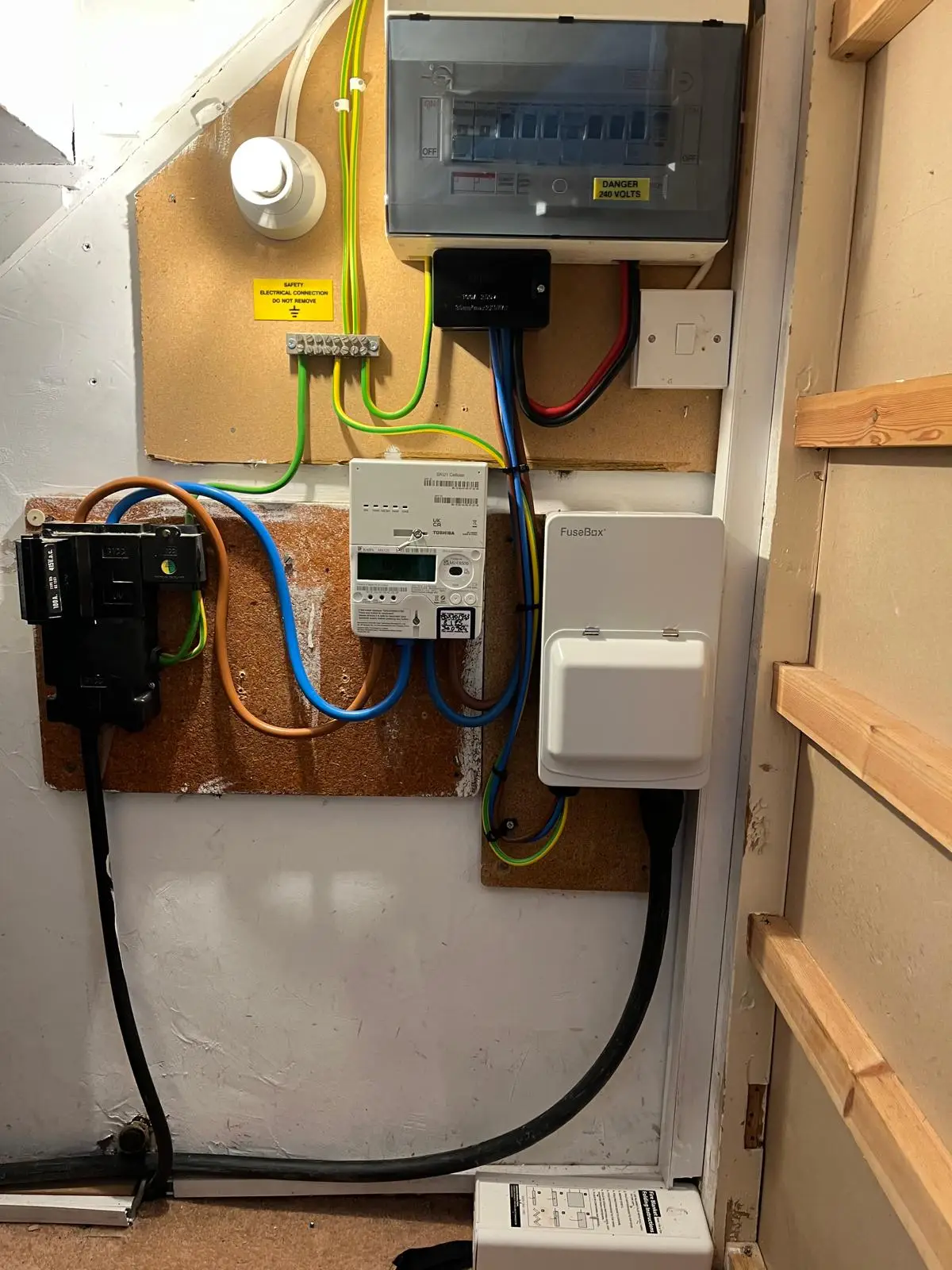
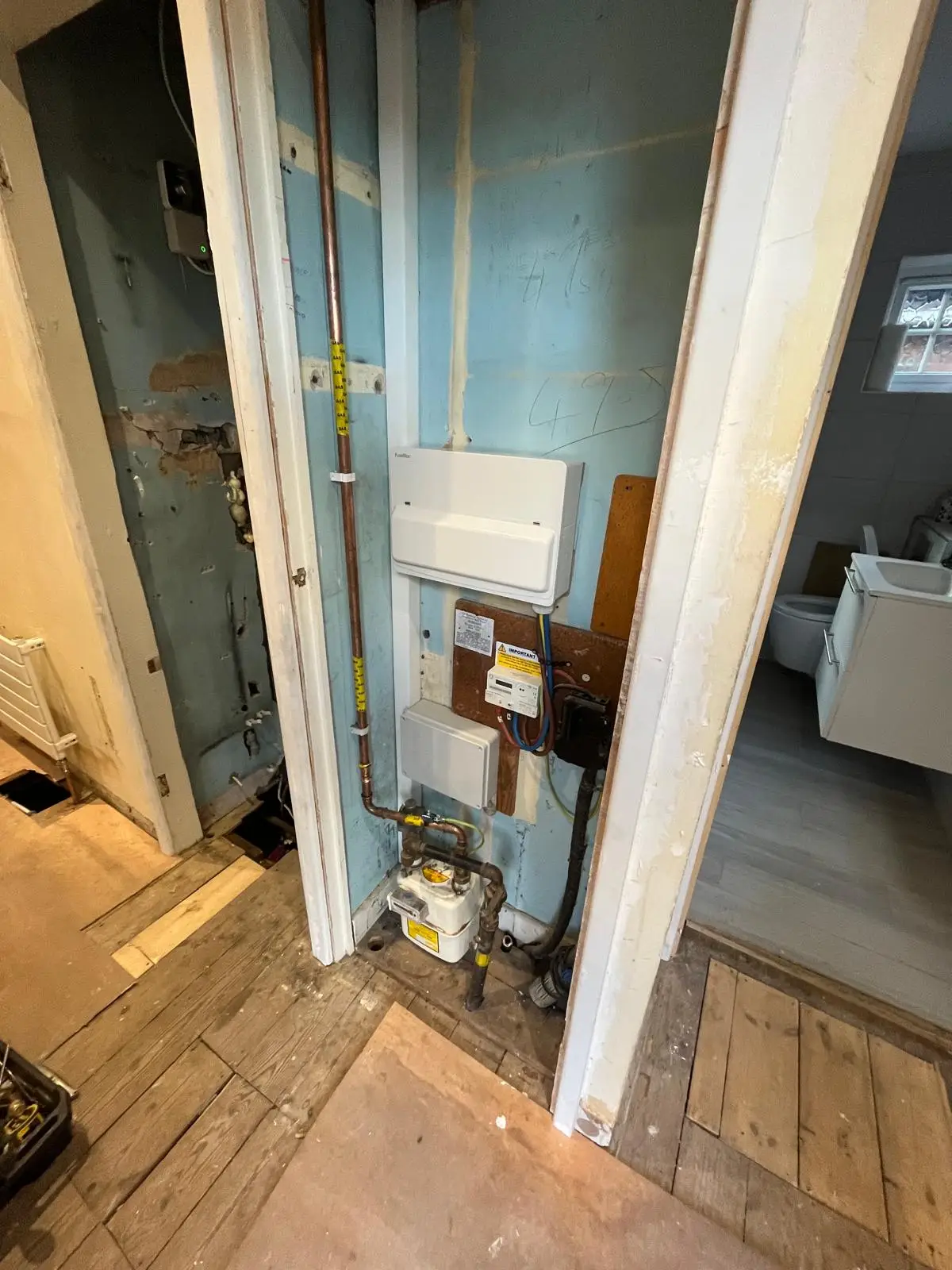
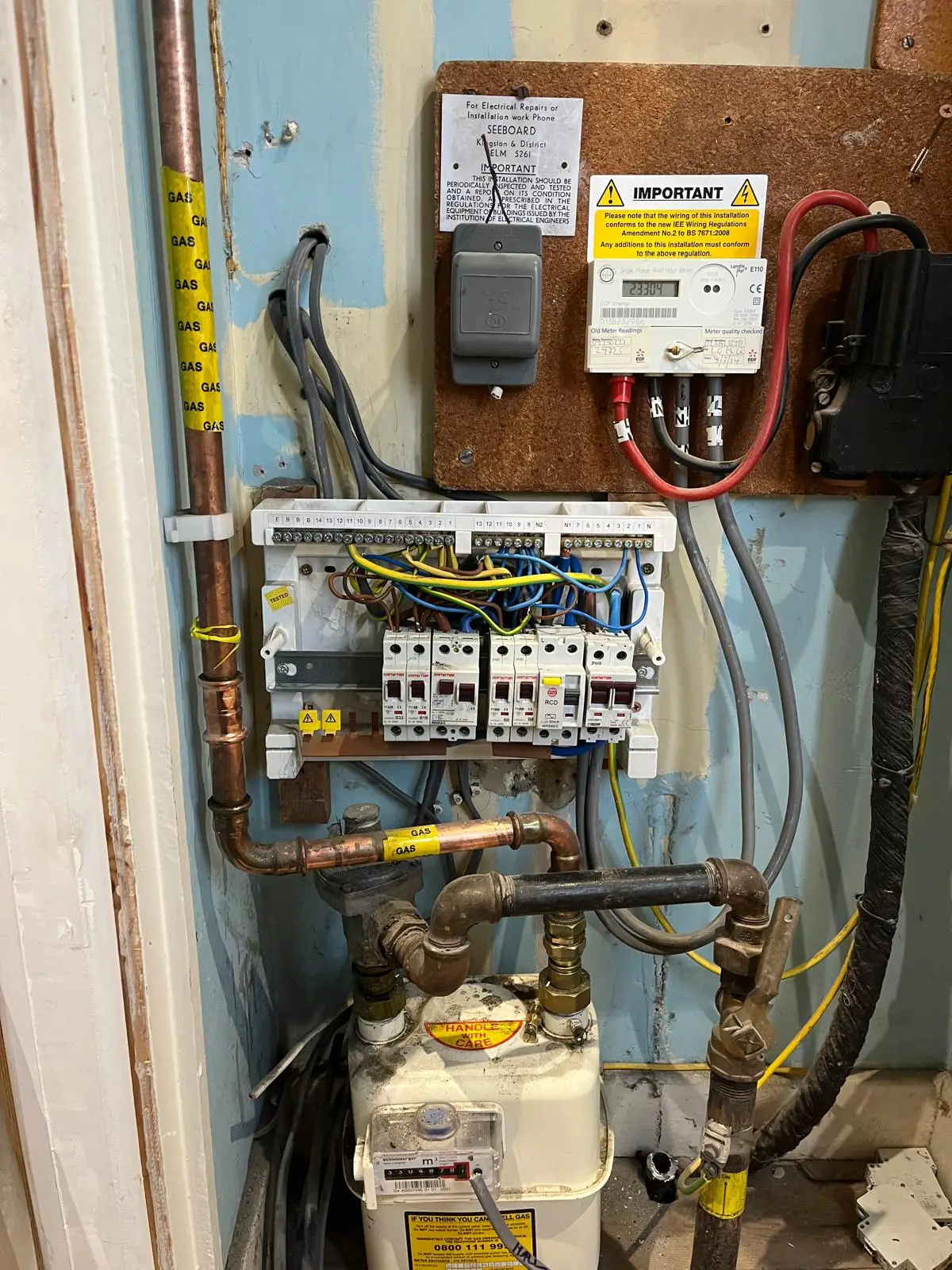 Before
After
Drag the slider to compare the board before and after Paul's remedial work.
Replacing an Unsafe Consumer Unit Left Open by a Builder
A Walton-on-Thames homeowner returned from holiday to find no power and her fuse board left open, with live connections exposed, after a builder walked away from an unfinished job. Paul inspected the board and found it posed a serious fire and shock risk:
- Loose neutral connections inside the consumer unit, liable to overheat under load.
- An open enclosure giving direct access to live parts.
- Poor terminations and missing earth continuity on the circuits it supplied.
Paul fitted a new consumer unit in the meter cupboard, remade every connection, restored earth continuity and tested each circuit before restoring the power. The installation was left safe, compliant and clearly labelled.
The customer was hugely relieved, and she has since asked Paul back for further electrical work.
What Is Included in an 18th Edition Consumer Unit Upgrade?
Every consumer unit installed by Bring it Ohm adheres strictly to the current edition of BS 7671, the IET Wiring Regulations. Each board is specified for your property, your circuits and the equipment you plan to add.
- Non-Combustible Steel Enclosure A metal casing designed to contain an internal electrical fire. BS 7671 requires consumer units in domestic premises to have an enclosure made from non-combustible material.
- Individual RCBO Protection A Residual Current Breaker with Overcurrent protection combines an MCB and an RCD in one compact device. If your kettle or outdoor light trips, only that circuit disconnects.
- Surge Protection Device (SPD) Protects sensitive electronics such as smart TVs, laptops, boiler controls and EV chargers from transient overvoltages caused by lightning or grid switching.
- Main Earthing & Bonding Verification Paul inspects the main earth conductor and the protective equipotential bonding to incoming gas and water pipework, confirming compliance before the board is energised.
- EIC & Part P Sign Off A formal Electrical Installation Certificate recording insulation resistance, continuity and loop impedance results, followed by local authority notification through NAPIT.
- Clear Circuit Labelling Every way is identified and labelled on a printed circuit chart, so you can find and isolate the right circuit quickly in future.
Ready for EV Chargers, Heat Pumps & Solar PV
Many homeowners in Weybridge, Oatlands and St George's Hill replace their consumer unit ahead of an EV charger, air source heat pump, induction hob or solar installation. Paul sizes the new board with spare ways and checks the incoming supply, main fuse rating and earthing arrangement, so future equipment can be connected without a second board change.
Where solar PV or battery storage feeds the board, Paul specifies RCBOs rated for bidirectional operation in line with Amendment 3 of BS 7671, along with Type A or Type B RCD protection wherever the equipment manufacturer calls for it.
- EV home chargers
- Air source heat pumps
- Solar PV panels
- Battery storage
- Induction hobs
- Extensions & outbuildings
The Installation Process: Step by Step
A typical replacement takes between four and eight hours. Paul works methodically through each stage, keeps disruption to a minimum and leaves the area clean and tidy.
- Survey & Bonding Check Paul assesses your existing wiring, incoming supply type (TN-S, TN-C-S or TT) and main earthing connections to confirm the circuits are safe to transfer to a modern board.
- Safe Isolation of the Main Supply The supply is safely isolated at the main service fuse or meter isolator switch, then proved dead before work begins.
- Decommissioning the Old Board Old fuses, carriers and casing are removed neatly, with every ring final, radial circuit and lighting circuit identified and labelled.
- Fitting the Steel Board & RCBOs The compliant metal enclosure is mounted and configured with a 100A double pole main switch, Type 2 SPD and RCBO ratings tailored to each circuit.
-
Full Instrument Testing
Before the power is restored, Paul carries out comprehensive dead and live testing with a calibrated multifunction tester:
- Earth continuity and conductor resistance
- Insulation resistance at 500V DC
- Polarity and earth fault loop impedance (Zs)
- RCD and RCBO trip times in milliseconds
- Certification & Handover Every circuit is labelled on the chart, Paul shows you how to use the test buttons, and the job is registered with NAPIT.
Frequently Asked Questions About Fuse Board Upgrades
Have a question about your own board? Call Paul on 07885 694524 and he will talk you through it.
How long does it take to replace a consumer unit?
A typical domestic consumer unit replacement takes between 4 and 8 hours. Power will be isolated for most of this time while cabling is tested and transferred to the new board.
Will a new consumer unit cause my circuits to trip?
Modern RCBOs are far more sensitive than old wire fuses. If an existing circuit has an insulation fault, damp ingress or a neutral to earth leak, the new device will detect it. Testing before the changeover identifies these problems so they can be rectified during the installation.
Do I receive a certificate afterwards?
Yes. Replacing a consumer unit is notifiable work under Part P of the Building Regulations. Paul issues an Electrical Installation Certificate (EIC) and notifies Elmbridge Borough Council building control through NAPIT, and you receive the official Building Regulations Compliance Certificate.
Do I have to replace a plastic consumer unit?
There is no legal requirement to upgrade an existing installation to current standards, and a plastic consumer unit in good condition with suitable RCD protection can stay in service. Any replacement board must have a non-combustible enclosure. An EICR will confirm whether your current board needs upgrading.
What happens if testing finds a fault on an existing circuit?
Paul shows you the test readings, explains what they mean and gives you a fixed price for the repair. A circuit with a dangerous defect stays disconnected until it has been repaired and retested.
Do you charge a call out fee to quote?
No. Bring it Ohm does not charge a call out fee or quoting charge across Weybridge, Walton-on-Thames, Cobham, Esher and neighbouring KT postcodes.
Book Your Consumer Unit Survey
Speak directly with Paul for a free, written quote across Weybridge and Surrey.