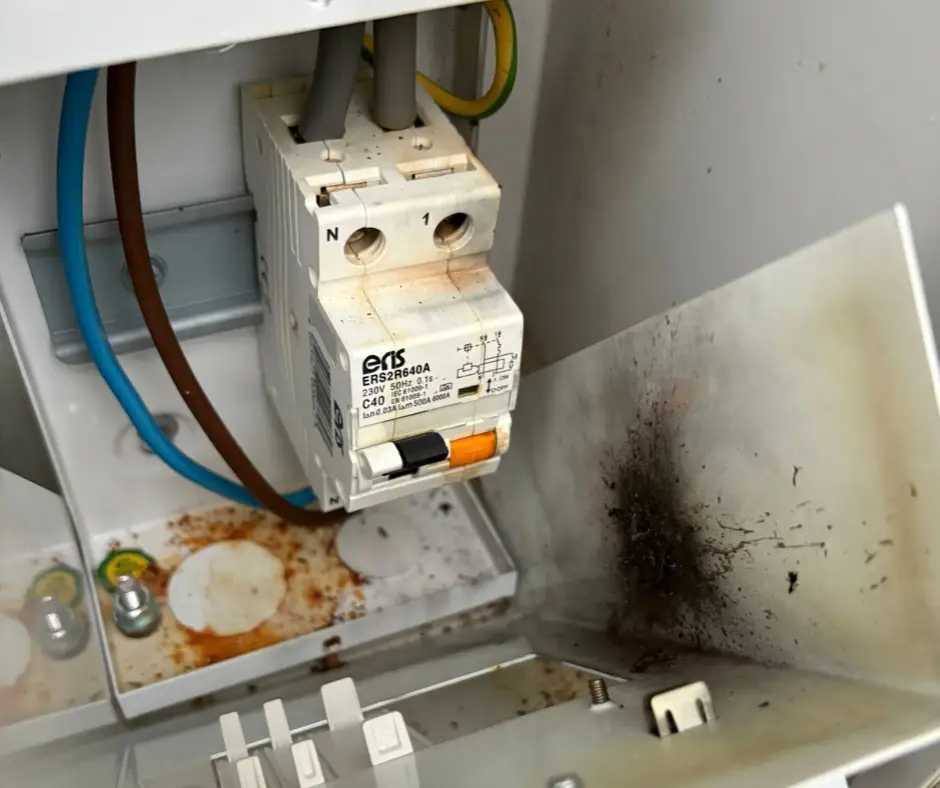
A short circuit is current taking a low resistance shortcut between conductors, an earth fault is current escaping to earth, and an arc fault is current jumping across a gap or loose connection. Each one behaves differently, trips a different protective device and carries its own risks. Paul, the Weybridge electrician behind Bring It Ohm, explains how to tell them apart and what to do when you suspect one.
How do short circuits, earth faults and arc faults compare?
The three faults differ in where the current goes and which device responds. The table below gives a quick comparison.
| Fault | What happens | Typical cause | Device that usually responds |
|---|---|---|---|
| Short circuit | Current takes a low resistance path between conductors and rises very quickly | Damaged insulation, crushed cable, loose conductors touching | Fuse, MCB or the overcurrent part of an RCBO |
| Earth fault | Current flows from a live conductor to earth or to earthed metalwork | Insulation failure, damp, faulty appliances, a nail through a cable | RCD or RCBO, and sometimes a fuse or MCB |
| Arc fault | Current jumps across a gap or poor connection, creating intense local heat | Loose terminals, damaged or crushed cables, deteriorated insulation | AFDD where fitted, though other devices may also trip |
Real faults don’t always fit neatly into one row. A live conductor touching earthed metal is both an earth fault and a high current fault, and an arc can start during either. More than one device can respond to the same event.
What is a short circuit?
A short circuit is an unintended connection that gives current a far lower resistance path than the circuit was designed for, most often where live and neutral conductors touch after insulation fails. With almost nothing to limit it, the current rises in a fraction of a second to many times the circuit’s normal load. A fuse or MCB then disconnects the circuit before the cables overheat.
Signs of a short circuit include:
- an MCB tripping instantly, often with a bang or flash
- a blown fuse in a plug or older fuse board
- scorch marks on a socket, switch, plug or appliance
- a burning smell after something switched off suddenly
A tripped breaker is a symptom of the fault, so the cause needs finding before the circuit or appliance goes back into use. Resetting it over and over puts stress on the cables and the breaker each time.
What is an earth fault?
An earth fault is current flowing from a live conductor to earth, either through the protective earth conductor or through metalwork that should never be live, such as an appliance case or a metal back box. In North America this is called a ground fault, and in the UK the two terms describe the same thing.
Your earthing system gives that fault current a safe route and helps the protective device disconnect the circuit quickly. An RCD adds a second layer of protection. It compares the current going out with the current coming back, and switches off within milliseconds if some is escaping to earth. That’s what protects a person who touches a live part.
Common causes include damaged cable insulation, water getting into outdoor fittings, faulty appliances and screws or nails driven through cables. An earth fault is also one of the most common reasons an RCD keeps tripping.
An RCD doesn’t replace a circuit breaker. It responds to leakage, while an MCB responds to overload and short circuits. An RCBO combines both in one device, which is why modern consumer units often use an RCBO for every circuit.
What is an arc fault?
An arc fault happens when current jumps across a gap or a poor connection instead of flowing through a sound conductor and a tight terminal. The arc produces intense heat in a very small area, hot enough to char insulation and ignite dust, timber or plastic nearby. It can start a fire even when the current is too low to trip a fuse or MCB.
Arc faults are usually linked to:
- loose screw terminals in sockets, switches, ceiling roses and consumer units
- cables crushed under floorboards or by furniture
- flexes damaged by doors, chair legs or pets
- a nail or screw that has nicked a cable without fully breaking it
- old, brittle insulation in ageing installations
Some arc faults happen in series along a single conductor and draw no more current than the normal load, so an MCB has nothing to react to. An AFDD (arc fault detection device) uses electronics to read the waveform on the circuit and recognise the pattern dangerous arcing creates. The IET’s guide to arc fault detection devices explains how they work and when they’re recommended.
Which protective device responds to each fault?
Each protective device in your consumer unit watches for a different condition, and no single device covers every fault on its own.
- Fuses and MCBs disconnect a circuit when the current rises too high, through overload or a short circuit.
- RCDs disconnect when current returns by an unexpected path, which protects against electric shock and some fire risks from earth leakage.
- RCBOs combine overcurrent and residual current protection for a single circuit.
- AFDDs detect the electrical signature of dangerous arcing and are usually combined with an RCBO in one module.
Under BS 7671:2018+A4:2026, AFDDs are required on single phase AC final circuits supplying socket outlets rated up to 32A in high rise residential buildings, houses in multiple occupation (HMOs), purpose built student accommodation and care homes. They are recommended for those circuits in other premises. BEAMA’s guides to AFDDs set out where they apply. If you’re having a consumer unit replaced, Paul can talk you through whether AFDDs are worth adding in your home.
What warning signs should you take seriously?
Any sign of heat, burning, noise or repeated tripping should be investigated, because one symptom rarely tells you which type of fault you have. A breaker tripping doesn’t prove a short circuit, and a scorched socket could be an arc, a short or an overloaded plug. Look out for:
- a breaker, RCD or RCBO that trips repeatedly
- crackling, buzzing or fizzing from a socket, switch or the consumer unit
- burn marks or brown discolouration on accessories or plugs
- sockets, switches or consumer unit parts that feel warm
- a burning or fishy smell that keeps coming back
- visible damage to cables or flexes
- lights flickering or power dropping out on one circuit
Don’t keep resetting a device that trips again. If you see sparking or smoke, notice a strong burning smell or find exposed live parts, switch off the affected circuit at the consumer unit and call an electrician urgently.
How does an electrician identify which fault you have?
An electrician identifies the fault by testing the circuit, since a tripped device or a damaged accessory only shows where to start looking. Paul safely isolates the affected circuit and proves it dead before carrying out insulation resistance tests between conductors and to earth. He then checks continuity of the live, neutral and protective conductors, inspects terminations for looseness or heat damage and tests the protective devices themselves.
The results show whether the problem is a short, an earth fault, a deteriorating connection or a faulty appliance, and where on the circuit it sits. When the fault lies somewhere along a hidden cable run, Paul uses cable fault finding to narrow it down before opening up any walls or floors. Live testing is never a homeowner task, so leave anything beyond resetting a breaker once to a registered electrician.
Frequently asked questions
What is the difference between a ground fault and an earth fault?
A ground fault and an earth fault are the same thing. “Ground fault” is the North American term, and UK guidance and electricians use “earth fault”. Both describe current taking an unintended path to earth.
Which device protects against a short circuit?
A fuse or an MCB protects against a short circuit by disconnecting the circuit when the current rises too high. An RCD on its own responds to earth leakage, so it’s the RCBO, which combines both functions, that covers short circuits and earth faults in a single device.
Why can an arc fault start a fire without tripping the breaker?
An arc fault can start a fire without tripping a breaker because a series arc along one conductor often draws no more current than the normal load. The MCB sees nothing unusual, while the arc concentrates heat at one point. An AFDD is designed to spot the electrical signature of that arcing and switch the circuit off.
How quickly should you call an electrician about a suspected fault?
You should call an electrician straight away if there’s sparking, smoke, a burning smell or a hot accessory, and turn off the affected circuit while you wait. For repeated tripping without those signs, book fault finding within a few days and stop using whatever appears to trigger it.
Need an Electrical Fault Found?
Call Paul at Bring It Ohm in Weybridge to test your circuits and find the cause of tripping, burning smells or power loss.