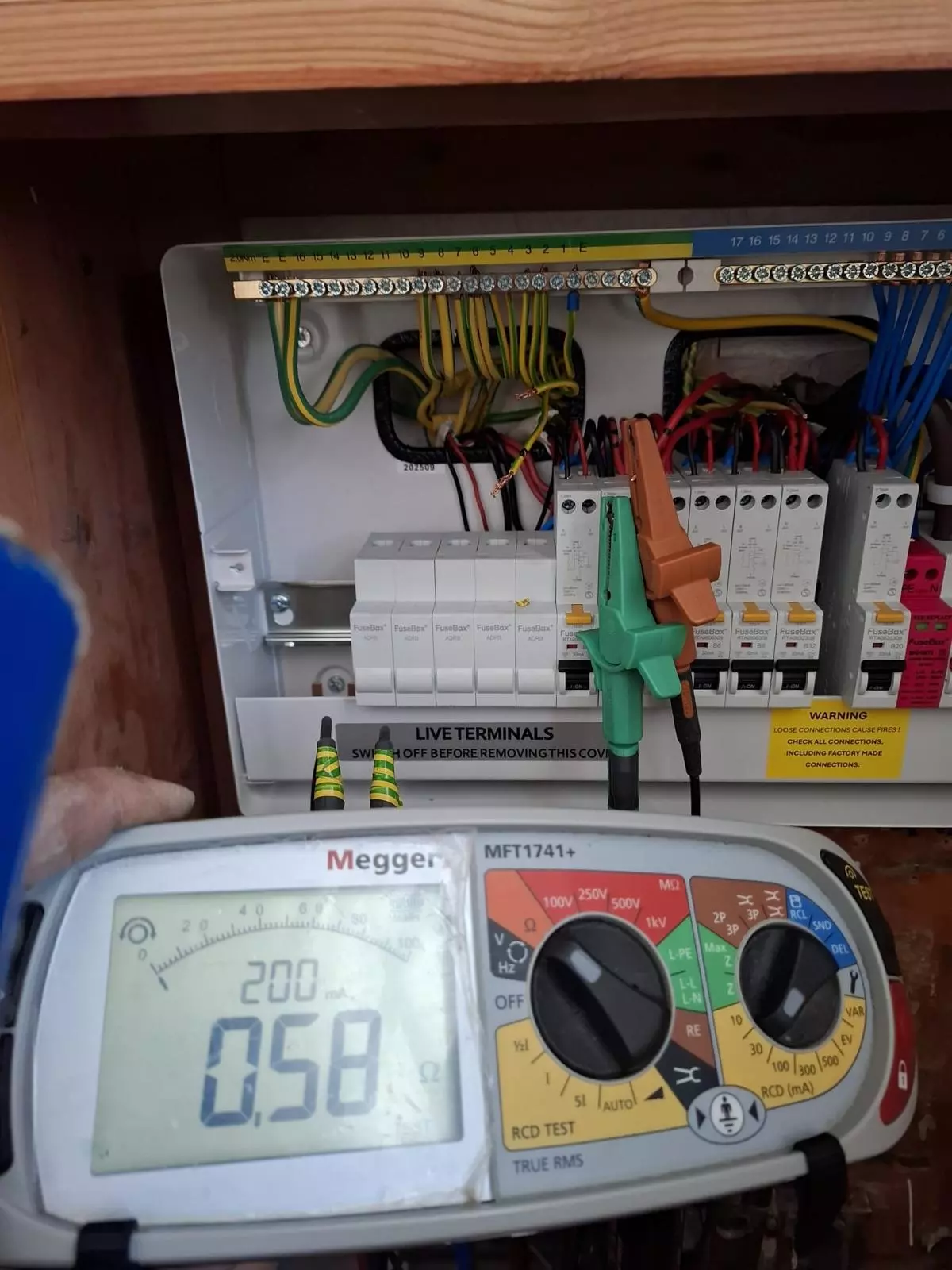
An RCD keeps tripping because it has detected electricity leaking to earth somewhere in your home, most often through a faulty appliance, damp, damaged wiring or several small leaks adding up behind one device. Paul, the Weybridge electrician behind Bring It Ohm, explains the ten most common causes, the checks you can safely make yourself and when it’s time to book electrical fault finding.
What does an RCD actually detect?
An RCD (residual current device) measures the current flowing out along the live conductor and back along the neutral, and it switches off the supply when the two no longer match. That difference means some current is escaping along a path it shouldn’t, usually to earth. A 30mA RCD will cut the power in a fraction of a second, which is fast enough to stop an electric shock from becoming fatal. Electrical Safety First explains this in its guide to how RCDs protect you.
When an RCD trips, it’s usually doing its job. The consumer unit is rarely the fault itself. The RCD is reacting to a problem somewhere on the circuits it protects, and the task is to find where that leakage is coming from.
Some leakage is normal. Laptops, televisions, LED drivers, washing machines and boilers all leak a small amount of current to earth by design. On one appliance it’s harmless, but when a dozen devices share a single RCD, those small amounts add together and leave the RCD very little headroom before it trips.
Is it the RCD, MCB or RCBO that keeps tripping?
The first step is to look at which device has switched off, because each one responds to a different kind of fault.
| Device | What it protects against | What a trip usually points to |
|---|---|---|
| RCD | Earth leakage and electric shock | Current escaping to earth from an appliance, damp or damaged wiring |
| MCB | Overload and short circuit | Too much load on one circuit, or live and neutral touching |
| RCBO | Both of the above, for a single circuit | Either earth leakage or overcurrent on that one circuit |
Running too many appliances at once normally trips an MCB. An RCD responds to leakage, though the extra leakage from lots of equipment running together can still push it over the edge. If you’re unsure which device has tripped, take a photo of the consumer unit before you touch anything. It will help your electrician later.
What are the 10 most common reasons an RCD keeps tripping?
1. A faulty appliance
A faulty appliance is the most common reason an RCD trips. Kettles, washing machines, dishwashers, tumble dryers, toasters and portable heaters all contain heating elements, and as an element ages its insulation can break down and leak current to earth. Unplug portable appliances and reconnect them one at a time to find the culprit.
2. A fixed appliance leaking to earth
Fixed appliances such as electric showers, ovens, hobs, immersion heaters and boilers can develop the same insulation faults, and they often trip the RCD only while they’re heating up. These are wired into the fixed installation, so don’t disconnect them yourself. Make a note of which appliance was running when the trip happened.
3. Moisture and water ingress
Water creates an easy path to earth. Outdoor sockets, garden lighting, garage supplies, shed cables and junction boxes are the usual suspects, especially if the RCD only trips during or after heavy rain. A leak from a bathroom or loft into a light fitting can cause the same problem indoors.
4. Damaged or ageing fixed wiring
Cables damaged by a stray nail, a drill bit, a crushed floorboard, rodents or heat can leak current wherever the insulation is broken. Older rubber and fabric insulation also becomes brittle with age. If the RCD still trips with every appliance unplugged, the fixed wiring becomes the likely cause, and an EICR or fault finding visit is the next step.
5. A neutral to earth fault
A neutral to earth fault happens when the neutral conductor touches earth somewhere it shouldn’t, often inside a back box or light fitting. It can sit unnoticed for months and then trip the RCD whenever a heavy load switches on elsewhere in the house. This kind of fault needs proper testing to locate.
6. Several small leaks adding up
Cumulative leakage from many electronic devices on one RCD is a growing cause of nuisance tripping in modern homes. The IET’s Wiring Matters article on earth leakage and unwanted tripping explains how the leakage from protected circuits can combine to trip an RCD. Most 30mA RCDs trip somewhat below 30mA, so the margin is smaller than many people expect.
7. A damaged socket, switch or light fitting
Accessories can leak current when they’re cracked, scorched, contaminated with dust or damp, or loose in the wall. Discolouration, a buzzing sound or a warm faceplate are all signs to stop using that point and have it checked.
8. A wiring error after recent work
If the tripping started after a kitchen fit, a new light, an extension or any other electrical work, a borrowed or shared neutral between circuits is a strong possibility. Tell your electrician exactly what work was done and when, because it narrows the search considerably.
9. An intermittent fault
Some faults only appear when a fridge compressor starts, a boiler fires, a heating element cycles on or an appliance switches off. Keep a simple log of when the RCD trips and what was running at the time. Patterns in that log often lead straight to the fault.
10. A faulty or worn RCD
RCDs can wear out and become oversensitive, but the device should only be blamed once the circuits and appliances have been tested. An electrician can ramp test the RCD to see the exact current it trips at. A faulty RCD can be replaced on its own, so it doesn’t automatically mean a new consumer unit.
What can you safely check when your RCD trips?
You can safely look for obvious signs of damage, note what was running and unplug portable appliances to rule them out. Anything beyond that needs an electrician.
- Look and smell before touching anything. If you see smoke, sparks, scorch marks or water near electrics, or notice a burning smell, leave the RCD off and call for help.
- Note what was switched on or running when the RCD tripped.
- Unplug portable appliances on the affected circuits, where it’s safe to reach the plugs.
- Reset the RCD once, and only if the consumer unit looks undamaged and isn’t hot.
- Plug appliances back in one at a time, waiting a few minutes between each. If one trips the RCD, leave it unplugged and have it repaired or replaced.
- If the RCD trips again with everything unplugged, book electrical testing.
Never bypass an RCD, tape or hold the switch on, or swap it for a less sensitive rating. It’s the device that stands between a fault and an electric shock.
Why won’t your RCD stay on when you reset it?
An RCD that trips the moment you reset it usually has a permanent fault on one of its circuits, such as a fixed appliance leaking to earth, a neutral to earth fault, water in a fitting or a failed RCD. Once portable appliances are unplugged and ruled out, resetting it again and again won’t find the cause and can put strain on the device. At this point the circuits need isolating and testing one by one.
Why does your RCD trip at random times?
An RCD that trips at random times is usually reacting to something that changes, and the timing is the best clue to what that is. Common patterns include:
- tripping in rain or damp weather, which points to outdoor circuits, garden lights or water ingress
- tripping when the heating, immersion, shower or oven comes on, which points to a heating element
- tripping overnight, often when a fridge, freezer or timed appliance starts
- tripping when several electronic devices are running, which suggests cumulative leakage
- tripping that began after building or electrical work, which suggests damaged cable or a wiring error
How does an electrician find the cause of RCD tripping?
An electrician finds the cause by working out whether the leakage comes from connected equipment, a particular circuit, the fixed wiring or the RCD itself. Paul starts with a visual inspection and a conversation about when the trips happen. He then isolates the circuits, measures earth leakage with a clamp meter, carries out insulation resistance tests on each circuit and ramp tests the RCD.
That approach finds the fault with evidence, which saves you paying for parts that were never the problem. Testing also shows whether the fix is a single repair, a replacement appliance, a new accessory or a wider job such as a partial rewire.
[PAUL’S JOB: add a recent RCD tripping job here. Which town, what the customer noticed, what Paul tested and what the cause turned out to be, for example a leaking immersion heater or water in an outdoor light.]
Should you replace an RCD that keeps tripping?
You should only replace an RCD once testing shows the device itself is faulty or unsuitable. Swapping it first often hides the real fault, and a new RCD will trip just like the old one if the leakage is still there.
Upgrading to a consumer unit with RCBOs can still be worthwhile. Each circuit then has its own protection, so a fault on the kitchen sockets no longer takes out the lights and the rest of the house as well. Leakage is spread across many devices, which cuts nuisance tripping, and the device that trips tells you straight away which circuit has the problem. It doesn’t remove the underlying fault, though, so that still needs finding and fixing.
How often should you press the RCD test button?
You should press the RCD test button every few months, following the label on your consumer unit, which often says “test quarterly”. Pressing it checks that the switching mechanism still works. It doesn’t test your wiring or your appliances. If the RCD doesn’t switch off when you press the button, or won’t reset afterwards, have it checked by a registered electrician.
When is a tripping RCD an emergency?
A tripping RCD becomes an emergency when it comes with signs of heat, burning or damage. Leave the power off at the affected circuit and call an electrician straight away if you notice:
- a burning, melting or fishy smell
- sparking, crackling or arcing
- smoke from a socket, fitting or the consumer unit
- a hot consumer unit, socket or light fitting
- exposed or damaged cables
- water near electrical equipment
Frequently asked questions
Why does an RCD keep tripping when nothing is plugged in?
An RCD that trips with nothing plugged in usually has a fault on the fixed installation, such as damaged cable, a neutral to earth fault, water in a fitting or a fixed appliance like a shower or immersion heater leaking to earth. A faulty RCD is also possible. Insulation resistance testing on each circuit is the reliable way to find out which.
What is the difference between an RCD tripping and an MCB tripping?
An RCD trips when it detects current leaking to earth, while an MCB trips when a circuit draws too much current through overload or a short circuit. An RCBO combines both, so a trip on an RCBO could be either type of fault on that one circuit.
How much does it cost to find the cause of a tripping RCD?
The cost of finding the cause depends on how many circuits need testing and how intermittent the fault is. Pauls charges from £75 and confirms the cost before he starts and explains what he’s found before any repair goes ahead.
Which areas does Bring It Ohm cover for RCD fault finding?
Bring It Ohm covers Weybridge, Walton-on-Thames, Addlestone, Hersham, Cobham, Byfleet and the surrounding Elmbridge area for electrical fault finding. If you’re nearby, send your postcode through the contact page and Paul will confirm.
RCD Keeps Tripping?
Call Paul at Bring It Ohm in Weybridge to test your circuits, trace the leakage and fix the fault safely.